
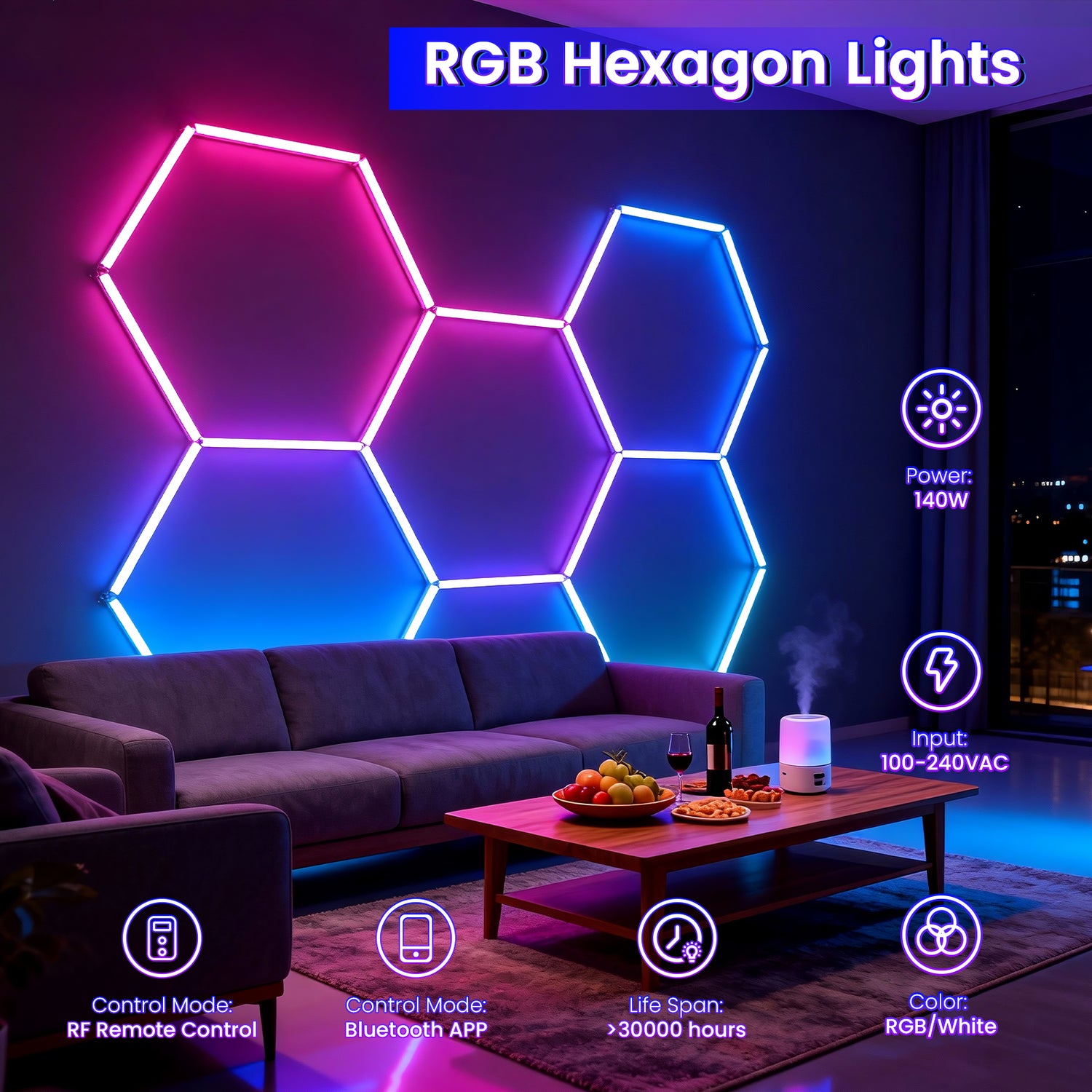
Fitness center owners know the struggle all too well: dimly lit corners where members hesitate to train, harsh overhead glare that strains eyes during floor exercises, and monthly electricity bills that eat into already tight margins. Traditional lighting setups force an uncomfortable compromise between adequate brightness and manageable costs. Poor illumination does more than create an uninviting atmosphere—it introduces genuine safety risks when members can’t clearly see equipment, floor edges, or proper form in mirrors. Meanwhile, outdated fluorescent and metal halide fixtures consume excessive energy while delivering subpar results. Hexagon lights have emerged as a compelling dual-purpose solution that addresses both problems simultaneously.
These modular LED panels combine striking geometric aesthetics that energize and motivate with advanced efficiency that dramatically reduces power consumption. Their honeycomb-inspired design transforms ceilings into architectural features while delivering uniform, high-quality illumination across every square foot. This guide explores how hexagon lighting solves these core business challenges, covering everything from the science behind effective gym illumination to practical implementation steps and measurable energy savings that impact your bottom line.
Why Hexagon Lights are Revolutionizing Gym Lighting Design
Hexagon lights are modular LED panels shaped as interlocking hexagons that connect seamlessly to create expansive, customizable ceiling installations. Each panel functions as an independent light source, yet when linked together, they form a continuous illumination system that eliminates the gaps and inconsistencies plaguing traditional setups. Unlike conventional fluorescent tubes that cast linear shadows or standard flat panels that produce monotonous, institutional lighting, hexagon fixtures deliver multidirectional output from their geometric faces, scattering light evenly across wide areas.
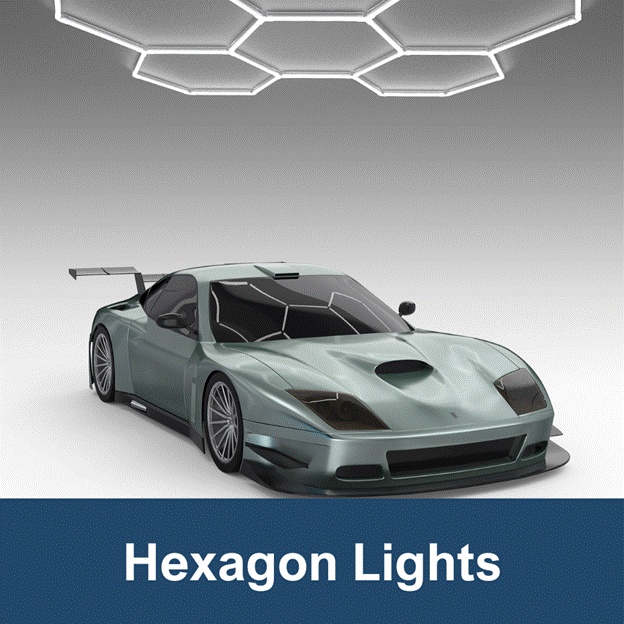
For fitness centers, this design translates into three critical advantages. First, the shadow-reducing distribution ensures members can see equipment edges, platform boundaries, and their own form in mirrors without visual dead zones—a direct safety improvement that reduces accident liability. Second, the striking honeycomb aesthetic creates an instantly recognizable, Instagram-worthy environment that strengthens brand identity and attracts new members. The geometric pattern signals modernity and energy, subconsciously reinforcing the motivation members seek in a training space. Third, these panels are built to withstand the vibrations, temperature fluctuations, and humidity common in high-activity environments, with solid-state LED construction that contains no fragile filaments or gas tubes susceptible to breakage from nearby impacts. Their robust housing resists dust accumulation and requires minimal cleaning compared to recessed troffers with diffuser panels. As optimal workspace lighting for athletic settings, hexagon fixtures bridge the gap between functional performance and design-forward aesthetics that traditional options simply cannot match.
The Science of Superior Workspace Lighting for Fitness
Effective gym illumination isn’t simply about flooding a space with brightness—it requires understanding how light interacts with human physiology and physical activity. Lumens measure total light output, and fitness environments typically demand between 300 and 500 lux at floor level to ensure clear visibility during dynamic movements. Color temperature, measured in Kelvin, plays an equally critical role in setting the right atmosphere. Cooler temperatures between 5000K and 6500K mimic natural daylight, triggering alertness and boosting energy levels—exactly the psychological state members need during intense training sessions. Warmer tones below 4000K work better in yoga studios or recovery areas where relaxation takes priority.
The Color Rendering Index measures how accurately a light source reveals the true colors of objects and skin tones. A CRI above 80 is essential in gyms where members rely on mirror reflections to assess form, muscle engagement, and even complexion during exertion. Low-CRI lighting distorts visual feedback and creates an unflattering environment that subtly discourages prolonged visits. Beyond these metrics, uniformity ratio determines whether a space feels cohesive or fragmented. Dark spots between fixtures create tripping hazards near benches, cable machines, and transition areas between zones. Glare from poorly positioned sources causes squinting during overhead presses or supine exercises. Hexagon panels address these demands through their tessellating geometry, which distributes output across overlapping coverage areas. The result is consistent, comfortable workspace lighting that maintains brightness standards without creating harsh concentrations or neglected shadows across workout floors, group studios, and functional training zones.
Bright Garage Lights Principle: Application for Functional Zones
Functional training areas share surprising similarities with garage workspaces—both require intense, unobstructed illumination covering large open floors where heavy equipment and complex movements demand absolute visual clarity. Just as bright garage lights eliminate shadows beneath vehicles and around tool stations, hexagon panels deliver wide-beam, high-lumen output that saturates weightlifting platforms, CrossFit boxes, and stretching zones without leaving pockets of darkness.
Athletes performing Olympic lifts need to see barbell paths clearly, while those using plyometric boxes must perceive edge boundaries with precision to avoid missteps. The broad, overlapping light distribution from interconnected hexagon modules ensures that regardless of where a member stands or which direction they face, illumination remains consistent and strong. This principle of total coverage directly enhances both safety during maximum-effort lifts and performance confidence during agility drills, making every rep and landing visible from every angle.
Designing Your Gym Layout with Hexagon Light Panels
The modular nature of hexagon panels transforms lighting design from a purely functional decision into a creative branding opportunity. Each hexagonal unit clicks into adjacent panels at any of its six sides, enabling configurations that range from tight clusters over specific stations to sweeping linear arrangements that guide members through a space.
A concentrated honeycomb cluster above a weightlifting platform signals intensity and focus, while a flowing trail of panels leading from the entrance through cardio rows creates natural wayfinding without additional signage. Some facility owners arrange panels into custom shapes—brand logos, arrows pointing toward class studios, or expanding patterns that visually enlarge smaller rooms.
Finish selection reinforces the atmosphere you want each zone to convey. White-framed panels suit bright, open cardio areas and yoga studios where cleanliness and calm matter most. Black housings add industrial edge to functional training zones and free weight areas, complementing exposed ductwork and dark rubber flooring. RGB color-changing modules let you shift ambiance for cycling classes, evening boot camps, or special events without permanent fixture changes.
When planning layouts, account for ceiling height—spaces above twelve feet benefit from larger panel clusters mounted slightly lower to maintain lux levels at floor height. Highly reflective surfaces like mirrors and light-colored walls amplify output, meaning fewer panels achieve target brightness in mirrored studios compared to dark-walled boxing areas. Mapping these variables before purchasing ensures every panel serves both aesthetic and functional purpose without overspending on unnecessary modules.
How Hexagon Lights Deliver Major Energy Savings
For fitness center owners watching operational costs climb, the switch to hexagon LED panels represents one of the most straightforward paths to measurable savings. Traditional metal halide fixtures commonly used in gyms consume between 250 and 400 watts per unit while requiring fifteen to twenty minutes of warm-up time before reaching full brightness—wasted energy every single morning.
Standard fluorescent tubes run at 32 to 54 watts per tube but degrade rapidly in output, losing up to 30 percent of their brightness within two years while still drawing full power. Hexagon LED panels deliver equivalent or superior lumen output at a fraction of the wattage, typically consuming 40 to 72 watts per module while maintaining consistent brightness throughout their operational life.
Consider a mid-sized gym running forty metal halide fixtures at 300 watts each for fourteen hours daily. That configuration draws 168 kilowatt-hours per day. Replacing those with hexagon LED panels producing comparable illumination at 60 watts per module drops daily consumption to roughly 33.6 kilowatt-hours—an 80 percent reduction that translates to hundreds of dollars saved monthly depending on local utility rates. The savings compound further when you factor in maintenance. Metal halides require bulb replacement every 6,000 to 15,000 hours, while hexagon LEDs maintain performance for 50,000 hours or more, effectively eliminating replacement labor and material costs for years.
Beyond raw efficiency, these panels offer intelligent control features that push savings even further. Dimmability allows you to reduce output during low-traffic hours or when natural light supplements interior illumination through windows. Programmable smart controls let you schedule brightness levels around class times—full intensity during peak morning and evening sessions, reduced output during slower afternoon periods. Some systems integrate occupancy sensors that dim or deactivate panels in unused zones automatically. These energy-saving lights don’t ask you to sacrifice quality for economy; they deliver both simultaneously, turning your ceiling into an asset that pays for itself through reduced utility bills within twelve to eighteen months of installation.
Step-by-Step: Implementing Hexagon Lights in Your Fitness Center
Transforming your gym’s lighting doesn’t need to be overwhelming when you approach it as a structured project with clear milestones. Following a systematic implementation process ensures you maximize both the aesthetic and financial benefits while avoiding costly mistakes that come from rushing into purchases without proper planning.
Begin with a thorough audit of your existing setup. Walk your facility during operating hours and document every problem area—dim corners near cable machines, glare zones above bench press stations, flickering tubes in group studios. Pull your last twelve months of electricity bills and calculate what percentage goes toward lighting alone. Most gyms find it accounts for 35 to 45 percent of total energy costs. Map your floor plan into distinct zones: cardio, free weights, functional training, studios, reception, and corridors. Each zone has different illumination requirements and aesthetic goals, and identifying these upfront prevents over-ordering or under-specifying panels.
Product selection comes next, and specifics matter enormously. For high-intensity zones like weightlifting platforms, prioritize panels offering 5000K to 6500K color temperature with output exceeding 4000 lumens per module. Manufacturers like Hyperlite offer hexagon LED systems designed specifically for demanding commercial environments, with high-lumen modules and smart connectivity built in. Yoga and stretching areas benefit from tunable panels that shift between warm and cool tones depending on class type. Verify that any system you consider offers wireless dimming, scheduling through mobile apps, and occupancy sensor compatibility. These features aren’t luxuries; they’re the mechanisms that deliver ongoing savings after installation day.
Professional installation is non-negotiable for commercial fitness environments. A licensed electrician ensures your electrical panel can handle the new load, verifies code compliance for your municipality, and properly secures mounting hardware to support panel weight across suspended or grid ceiling systems. Gym ceilings often conceal HVAC ductwork, sprinkler lines, and speaker wiring that require careful navigation.
Attempting DIY installation risks damaging these systems and voiding both your building insurance and product warranties. Discuss wire management and control placement with your installer before work begins so switches and dimmers end up in logical, accessible locations for staff.
Once panels are mounted, configure your control ecosystem deliberately. Program automated schedules that align with your operating hours—full brightness thirty minutes before opening, gradual dimming during the final hour, complete shutoff after closing. Create scene presets for different class types: energizing cool white for HIIT sessions, warmer reduced output for evening yoga, dynamic color shifts for cycling classes. Train front-desk staff on manual overrides so they can respond to unexpected schedule changes without calling management.
Finally, measure results rigorously to confirm your return on investment. Compare monthly energy bills against your pre-installation baseline, tracking kilowatt-hour reductions rather than just dollar amounts to account for seasonal rate fluctuations. Survey members within the first month about visibility, comfort, and overall atmosphere—their feedback often reveals adjustment opportunities you wouldn’t notice yourself. Document maintenance events, which should drop to near zero compared to your previous bulb replacement frequency. Most facilities see full payback within twelve to eighteen months, after which every dollar saved flows directly to your bottom line as pure operational profit.
Transform Your Gym with Hexagon Lights for Lasting Results
Hexagon lights directly address the two most persistent challenges facing fitness center owners: creating workout environments where members feel safe, energized, and motivated to return, while simultaneously reducing the operational costs that erode profitability month after month.
The combination of shadow-free, high-quality illumination and dramatic energy reductions of up to 80 percent compared to legacy fixtures makes this technology uniquely positioned to solve both problems through a single infrastructure upgrade. Members train with greater confidence when they can clearly see equipment, floor boundaries, and their own form.
They stay longer in spaces that feel modern and intentionally designed rather than institutionally lit. Meanwhile, the financial impact compounds quietly in the background—lower utility bills, eliminated bulb replacements, and reduced maintenance labor that frees staff for member-facing tasks. Lighting should no longer be viewed as a passive overhead expense that simply keeps the lights on. It’s a strategic investment that shapes member experience, reinforces brand identity, and generates measurable returns. The facilities gaining competitive advantage today are those treating their ceilings as opportunities rather than afterthoughts. Start with an honest audit of your current setup, quantify what inefficiency is costing you, and take the first concrete step toward a hexagon lighting transformation that pays dividends for years to come.
