
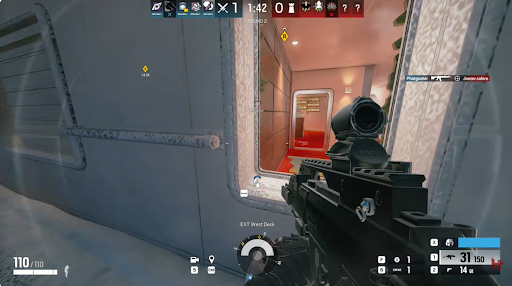
Defense wins rounds in Rainbow Six Siege. Not aim. Not reaction time. Defense.
The teams climbing ranked in 2026 aren’t winning because they have faster fingers. They’re winning because they control information, shape sites with utility, and bleed attackers dry on time before a plant ever happens.
This guide breaks down exactly how that works — from the best defenders in the current meta to how you position, roam, and communicate like a coordinated unit rather than five people hoping for the best.
The Three Pillars of Meta Defense in 2026
Forget “sit on site and wait.” That approach loses to any structured attack in high-level play. Modern defense is built around three things:
Site shaping means using utility to redesign the bombsite itself. Operators like Azami, Mira, Smoke, and Goyo don’t just defend space — they physically restructure it with Kiba Barriers, Black Mirrors, and Volcán canisters that force attackers into unfavorable angles.
Information control is where teams like Valkyrie, Mute, Solis, Mozzie, and Echo earn their value. Either you’re denying attacker intel or flooding your own team with it. The side that knows more almost always wins the late round.
Time pressure is the final piece. Operators like Thorn, Melusi, Lesion, Kapkan, and Tubarão don’t need kills to be effective. Their utility forces attackers to slow down, clear traps, and plant on a compressed clock rather than their own comfortable timing.
Every operator selection, every camera placement, every rotation — it all feeds back into these three pillars.
Best Defenders in Rainbow Six Siege 2026
The current meta has a clear tier of must-picks and high-value flex options. Here’s where things stand heading into Operation Silent Hunt (Y11).
S-Tier: Essential Defenders
Azami is arguably the strongest defender in the game right now. Her Kiba Barriers let her manufacture headshot angles from nothing, block dangerous lines of sight, and patch holes that would otherwise hand attackers free information. She also carries impact grenades and strong primary options, making her useful at every stage of a round.
Mira remains one of the most oppressive picks in the game. Black Mirrors hold default plant spots, create pixel angles, and generate the kind of late-round pressure that forces attackers to fully commit before they’re ready. The Vector .45 ACP gives her one of the fastest TTKs on defense.
Smoke is the premier plant-denial anchor. With toxic canisters, the M590A1 shotgun, and the SMG-11 secondary, he can stall a full execute alone if his canisters are timed correctly. No serious team goes into a ranked match without him.
Bandit and Kaid provide hard-breach denial that’s simply non-negotiable. Bandit’s active “tricking” playstyle gives him a higher skill ceiling, while Kaid is particularly valuable on hatch-heavy sites like Clubhouse and Bank basements where vertical control matters.
Goyo brings lasting area denial through Volcán canisters that continue burning long after he’s dead. His access to the Vector or TCSG12 and flexible secondary gadgets makes him a powerful anchor option even in late-round 1v1 scenarios.
High-Impact Meta Picks by Role
Roamers and flex: Lesion with the T-5 SMG, Jäger with the 416-C and ADS, Ela or Denari with Scorpion trap utility, Skopós as a body-swapping AR roamer, and Thorn with buffed traps and shield all offer strong map presence early in rounds.
Intel and denial: Valkyrie for Black Eye cameras, Mozzie for stealing drones, Solis for gadget scanning, Echo for Yokai plant denial, and Mute for jamming drone lines and running the SMG-11 into aggressive anchor positions.
Defender Weapon Meta: What You Should Be Running
The 2026 weapon meta on defense is dominated by high-RPM SMGs with controllable recoil. Most defensive gunfights happen inside or just outside site — distances where fire rate beats raw damage every time.
The S-tier defender weapons right now are the T-5 SMG (900 RPM, roughly 200ms TTK on 1-armor targets), the MP7 (900 RPM, even faster at around 190ms TTK), the Vector .45 ACP (1200 RPM, devastating TTK of ~150ms but with sharp vertical recoil that punishes lazy trigger discipline), and the SMG-11 (1270 RPM, ~140ms TTK, used almost as a primary by Smoke, Mute, and Solis).
Choosing operators who have access to these weapons isn’t a coincidence — it’s a loadout decision. Anchors running Smoke, Mira, or Goyo pair naturally with these options. Roamers on Lesion, Bandit, or Ela benefit from the same SMG-first philosophy. Burst control matters, particularly with the Vector and SMG-11. Short five-to-seven round bursts keep shots on target far better than full-auto sprays at medium range.
Defensive Positioning: Site Setups and Map Control
Position is where most defenders lose rounds they should win. A few principles that hold across almost every site in the game:
Always build crossfires. Two defenders holding the same doorway from separate angles is worth more than two defenders stacked behind the same wall. One player baits, the other trades from a protected position. It sounds simple. Most players still don’t do it consistently.
Vertical control wins plants. Competitive defenders frequently play a floor above or below the default plant spot, threatening C4 lines and vertical angles that anchors at ground level simply can’t match. If attackers control vertical, they control the plant.
Use Azami and Mira to manufacture “power positions” — protected off-angles that cover both the default plant and the primary entry point simultaneously. These setups don’t happen by accident. They require early communication and deliberate reinforcement choices.
Roaming vs. Anchoring: Choosing Your Role
High-level teams keep at least one flex player who can do both, but understanding the core difference between roles sharpens every defensive round.
Roamer Fundamentals
Roamers exist to contest early map control and burn attacker resources — time, drones, grenades, and utility — before the execute ever starts. Early aggression is valuable, but survival matters more than hero plays. A roamer who dies in the first 30 seconds provides almost no value regardless of how much noise they made getting there.
Strong roamers rely heavily on Valk cams, Mute jammers, Mozzie pests, and audio cues to re-position constantly without running blind. Vertical play and late flanks — hitting attackers from behind once they’ve committed utility to site — are what separate competent roamers from great ones.
Anchor Fundamentals
Anchors preserve utility for the late round. Smoke, Mira, Goyo, Melusi, and Echo should not be fighting early. Their gadgets win rounds in the last 30 to 40 seconds, and an anchor who dies at the 90-second mark without using a single canister or mirror is a round thrown.
Safe lines of sight and reinforced wall management are the mechanical side. The strategic side is sequencing plant denial — combining smokes, Goyo fire, C4, Yokai stuns, and bulletproof cams across multiple deny attempts rather than burning everything simultaneously. Make the planter fail three times, not once.
Sound Cues, Callouts, and Camera Play
Information wins rounds more reliably than aim at high levels. That means treating audio as data. Learn surface sounds — sprint on wood versus concrete versus carpet gives away vertical positioning before any camera confirms it. Track utility audio to predict push timing. Anchors in late-round scenarios often hold in complete silence, crouch-walking to avoid giving away position.
Callout systems need to be dense and fast. “Three lobby, one low HP, breach open, no smokes” tells anchors everything they need to make decisions. Standardize room names across your stack. Inconsistent callouts are just noise.
Camera placement separates reactive teams from proactive ones. Valkyrie’s Black Eyes belong on external entry points early — spawn roads, rooftop doors, rappel windows. Echo’s Yokai drones and Maestro’s Evil Eyes belong above or near default plant spots, ready for late-round denial. Combine Valk cams with Bandit or Smoke C4 throws for one of the most reliable competitive combos in the game.
Treat every camera like it’s worth more than a kill. Because at high level, it usually is.
Crosshair Placement and Mechanical Training
With TTK values as fast as they are on defense — 140ms to 200ms with S-tier SMGs — crosshair placement matters more than raw reaction speed. If the crosshair is already at head height on the entry angle, there’s no reaction required. The fight is won before it starts.
Pre-aim common swing angles on every bombsite and practice holding pixel angles with Mira, Azami, and Smoke setups in custom games. VOD review catches crosshair placement mistakes that feel invisible in the moment — peeking with the crosshair too low, too centered, or drifting off the expected entry line.
Some players also explore tools like a Rainbow Six aimbot to understand how optimal aim behavior looks frame-by-frame, using that as a reference point when reviewing their own footage and identifying consistency gaps.
Final Thoughts
Defense in Rainbow Six Siege isn’t passive. It’s an active, information-driven discipline built around utility management, coordinated communication, and deliberate positioning. The teams that win rounds aren’t necessarily the ones who aim the best — they’re the ones who control what their opponents know, where they can move, and how much time they have left to do anything about it.
Master the three pillars. Pick operators with intention. Preserve utility for the moments that matter.
