

Have you ever worked on a project that started well but then became confusing and difficult to manage?
New tasks were added on a regular basis, deadlines changed, and team members became unsure of their responsibilities.
This usually happens when a project does not have a clear scope statement.
A clear scope statement acts as a roadmap, outlining the goals, deliverables, boundaries, deadlines, and success criteria of the project.
Understanding the scope of a project helps teams stay on track, avoid scope creep, close communication gaps, and improve project planning.
In this blog, you will explore the importance of scope statements and how to write one effectively for successful project management.
What Is a Scope Statement in Project Management?
A scope statement is a key project management document that specifies the project’s objectives, deliverables, boundaries, timelines, and constraints.
It helps teams understand what work is included and excluded, as well as how project success will be measured. Understanding what a project scope statement includes helps teams stay aligned, avoid confusion, and prevent unnecessary changes during the project.
Example: If a company is developing a mobile banking app, the scope statement may include account login, fund transfers, and transaction history but exclude future AI-based financial advisory features.
A clear project scope helps software development teams avoid interruptions, budget issues, and unnecessary revisions from the start.
Key Elements of a Strong Scope Statement
A strong scope statement should include several key elements that effectively direct the project.
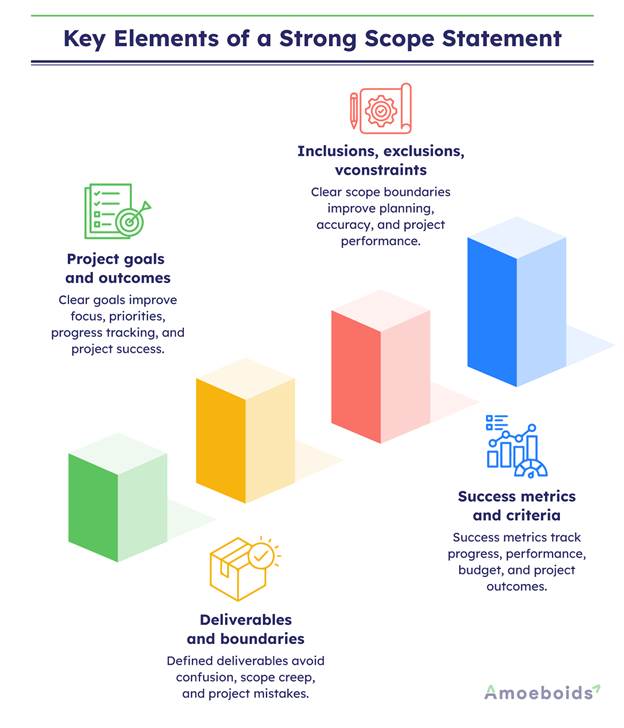
- Project goals and outcomes: Project goals explain why the project is being undertaken and what outcomes the team hopes to achieve. Clear project goals help teams stay focused, understand priorities, and track progress throughout the project.
- Deliverables and boundaries: Deliverables are the final products that a project is supposed to produce, such as software, reports, or websites. Clear project boundaries help teams understand what work is included and excluded, preventing confusion or scope changes later.
- Inclusions, exclusions, constraints: Project inclusions specify covered tasks and deliverables within the project scope. Exclusions and constraints allow teams to avoid confusion, manage constraints, and plan project activities more smoothly and accurately.
- Success metrics and criteria: Success metrics are used to define how the performance and outcomes of the project will be measured once it is completed. Clear success criteria allow teams to track progress, boost morale, and complete projects on time and within budget.
6 Steps to Write a Strong Scope Statement
Writing a scope statement doesn’t have to be complicated. Following a structured process can make things much simpler.
Step 1: Identify project goals
Understand the project purpose, expected outcomes, and business objectives clearly first. Specific project goals help teams focus, align stakeholder expectations, and successfully guide decision-making throughout the project’s lifecycle.
Step 2: Define deliverables clearly
Clear project deliverables describe exactly what the team must create or complete. Specific deliverables enhance responsibility, reduce confusion, and allow project teams to effectively manage deadlines and stakeholder expectations.
Step 3: Outline project boundaries
Defining project boundaries helps teams know what work is in the project scope. Proper scope boundaries help to reduce scope creep and excess workload while keeping project execution organised, realistic, and feasible. Clearly documented boundaries also help prevent scope creep and unauthorised project changes during execution.
Step 4: List assumptions carefully
Project assumptions are conditions considered true during project planning and execution. Documenting assumptions allows teams to identify risks early on, boost planning accuracy, and prepare for unexpected project changes.
Step 5: Document constraints
Project constraints include budgets, deadlines, technical dependencies, and resource availability. Documenting constraints allows teams to set realistic expectations, strengthen planning accuracy, and shorten project execution times.
Step 6: Review stakeholder requirements
A stakeholder requirements review helps teams understand expectations, clarify missing details, and improve project alignment. Strong stakeholder communication boosts collaboration, streamlines approvals, and ensures that projects run smoothly throughout their entire lifecycle.
Even a thorough scope statement can be rendered ineffective if important details are ignored during documentation.
Common Mistakes to Avoid When Writing a Scope Statement
Even experienced project managers can make mistakes when defining project scope. Here are some common issues to avoid.
- Unclear project goals: Unclear goals cause confusion and make it difficult to plan the project. Measurable goals help keep teams on track and increase productivity overall.
- Missing scope boundaries: Scope boundaries that are not clear often result in unnecessary work and scope creep. Simple inclusions and exclusions ensure that projects are controlled and organized.
- Ignoring stakeholder input: Not listening to stakeholders can lead to misunderstandings and unrealistic expectations. Communication on a regular basis helps to build collaboration, trust, and alignment on the project during execution.
- Undefined success metrics: It is difficult to measure project performance without clear success metrics. Teams can use defined KPIs to track progress and achieve project goals.
Best Practices for Creating an Effective Scope Statement
A successful scope statement is not only detailed but also practical and easy to understand. Here are some best practices to consider:
- Clear communication: Scope statements are more easily understood when written in simple and direct language. Clear communication reduces confusion and improves collaboration between stakeholders and team members.
- Realistic planning: Practical timelines, budgets, and resource planning all help to improve project execution. Proper planning reduces stress and helps teams to complete projects more efficiently.
- Stakeholder collaboration: Early stakeholder engagement helps project alignment and decision support. Client and team involvement also helps to prevent misunderstandings and future conflicts.
- Regular scope reviews: Teams that conduct regular scope reviews are better able to handle changes and modify priorities. Frequent reviews improve transparency and keep projects aligned with goals.
Conclusion
A strong scope statement helps teams remain focused, organised, and aligned throughout the project lifecycle. Clearly defining goals, deliverables, boundaries, and success criteria reduces confusion, prevents scope creep, and improves overall project performance.
Effective scope planning improves communication, responsibility, and stakeholder collaboration while reducing risks and delays.
So, don’t let unclear project expectations jeopardise project success.
Start writing clear and effective scope statements today and deliver projects with greater confidence, control, productivity, and long-term business success.
