
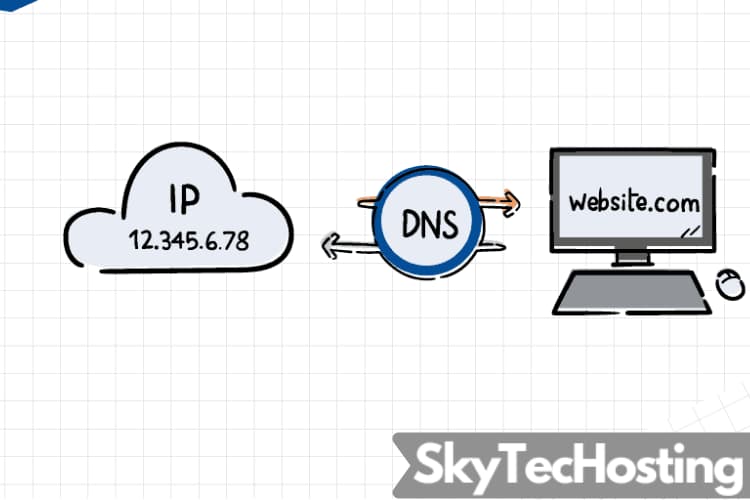
As companies integrate additional email providers, third-party applications, and sending services, managing SPF records can become progressively challenging. An automated SPF flattening service streamlines this task by minimizing DNS lookups, avoiding SPF errors, and ensuring that sender authorization remains current. This guide will detail how SPF flattening works, the significance of the 10-DNS-lookup limit, and how automated solutions can enhance email authentication and delivery rates.
What SPF Flattening Is and Why It Matters for Email Authentication
From nested includes to a flat list of IP addresses
SPF flattening is the process of converting an SPF record that contains multiple include statements, redirects, and other lookup-heavy mechanisms into a flat list of IP addresses authorized to send mail for a domain. Instead of asking receiving mail servers to perform many DNS lookups during SPF evaluation, SPF flattening pre-resolves those dependencies and publishes a simplified SPF TXT record.
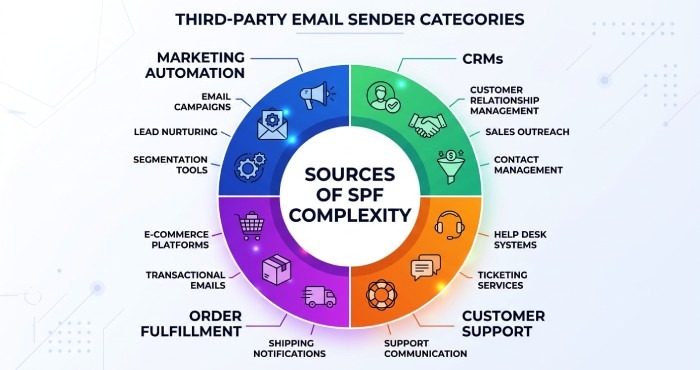
This matters because modern organizations rely on many third-party senders: Google Workspace, Office 365, SendGrid, Salesforce, Mailchimp, Campaign Monitor, WP Engine, CRMs, Marketing Automation platforms, Customer Support tools, Order Fulfillment systems, and other Email Providers. Each service often includes mechanisms to the SPF record. Over time, these nested includes create complexity, increase DNS lookups, and raise the risk of authentication failure.
A properly flattened SPF record replaces excessive nested includes with a flat list of IP addresses or optimized IP lists. The goal is not simply to shorten the SPF DNS entry visually, but to make sender authorization more reliable and improve email deliverability.
SPF in the broader authentication stack
SPF is an email authentication protocol defined in RFC 7208. It works by checking whether the sending mail server is authorized under the domain’s SPF policy. During SPF evaluation, the receiver retrieves the SPF record from DNS and validates the connecting IP address.
SPF works best alongside DKIM and DMARC. DKIM validates message integrity, SPF validates authorized infrastructure, and DMARC checks SPF alignment or DKIM alignment before applying DMARC enforcement. If SPF failure occurs because of a broken SPF configuration, messages may be quarantined, rejected, or marked suspicious—even if the sender is legitimate.
That is why SPF flattening is important for email security, authenticating senders, and preserving email deliverability across critical business functions.
The SPF 10-DNS-Lookup Limit and How It Causes Delivery Failures
Understanding the DNS lookup limit in RFC 7208
RFC 7208 defines a strict DNS lookup limit of 10 for SPF evaluation. This is often called the SPF 10-lookup limitation. The limit applies to mechanisms such as include, a, mx, ptr, exists, and redirect. If an SPF record requires more than 10 DNS lookups, the receiver returns an SPF permerror.
This SPF mechanism limit is not optional. It is built into SPF compliance to prevent excessive DNS traffic and protect DNS availability. When a domain exceeds the DNS lookup limit, mailbox providers may treat the message as unauthorized. This can cause SPF bounce events, spam placement, or complete rejection.
The problem is common because nested includes are easy to accumulate. A single include for Google, Office 365, SendGrid, Salesforce, or Mailchimp can reference additional includes. Those nested includes may reference still more DNS lookups. The domain owner may see only a few include mechanisms, while the actual SPF record exceeds the SPF 10-lookup limitation in the background.
Too Many Lookups Error and real-world deliverability risk
When the SPF record exceeds the DNS lookup limit, testing tools such as MxToolbox, DMARC Report, or an SPF Flattening Tool may show a Too Many Lookups Error. The Too Many Lookups Error indicates that the SPF record cannot be reliably evaluated under the SPF mechanism limit.
This is not a theoretical issue. A Too Many Lookups Error can lead to SPF permerror, SPF failure, and poor email deliverability. In regulated sectors such as Financial Services and Insurance, failures in email authentication can disrupt customer communications, policy notices, payment alerts, and compliance messaging.
The SPF 10-lookup limitation also becomes more difficult to manage as new Email Sources are added. Each new vendor may require its own SPF DNS entry update. Without SPF record optimization, nested includes continue to grow, DNS lookups increase, and the probability of a Too Many Lookups Error rises.
How an Automatic SPF Flattening Service Works
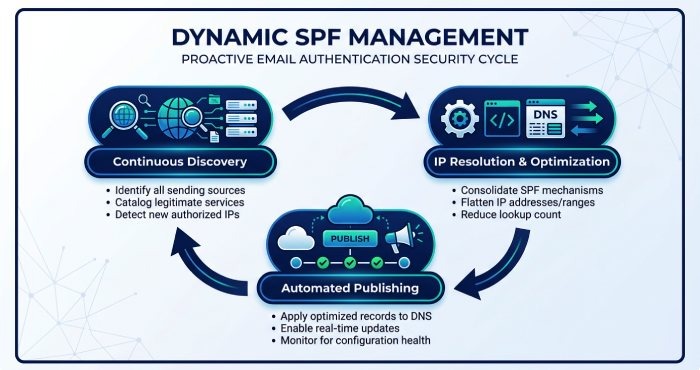
Continuous discovery, resolution, and publishing
An automatic SPF flattening service monitors your SPF record and resolves include mechanisms into authorized sending IPs. Instead of relying on manual SPF management, the platform performs automatic monitoring, detects changes from third-party senders, and updates the flattened output.
A service such as AutoSPF or another SPF management tool typically provides a hosted SPF TXT record or managed SPF DNS entry. You publish a simplified SPF record in your DNS provider—such as Cloudflare or another cloud DNS platform—and the service maintains the backend flattened data.
From raw includes to optimized IP lists
The technical value of automatic SPF flattening is SPF lookup reduction. The service evaluates the original SPF syntax, resolves DNS lookups, identifies overlapping IP ranges, and attempts to consolidate IP addresses into optimized IP lists.
Rather than publishing every IP separately, advanced SPF record management can merge adjacent ranges, remove duplicates, and reduce unnecessary mechanisms. This keeps the SPF record within the SPF mechanism limit while maintaining sender authorization for verified senders.
A well-designed automatic SPF flattening workflow includes:
- Discovery of all email sources and third-party senders
- Validation of include mechanisms and SPF macros
- Conversion into a flat list of IP addresses
- SPF record optimization to reduce DNS lookups
- Monitoring for vendor-side infrastructure changes
- Alerts for SPF permerror, SPF failure, or syntax issues
Handling SPF macros and special sender patterns
Some domains use SPF macros or macro-based SPF for dynamic authorization logic. SPF Macros can be powerful, but they require careful treatment because not every flattening approach handles them safely. A reliable provider should identify macro-based SPF patterns, explain whether flattening is appropriate, and preserve SPF compliance.
Macro validation
The service should inspect SPF macros during SPF evaluation and determine whether they are compatible with flattening.
Controlled exceptions
Where SPF macros cannot be flattened safely, the SPF management provider should offer documented exceptions instead of silently weakening the SPF policy.
Key Benefits: Improved Deliverability, Reduced Errors, and Easier Management
Better authentication outcomes at scale
The main benefit of SPF flattening is more reliable email authentication. By reducing DNS lookups and staying within the DNS lookup limit, a flattened SPF record avoids the SPF 10-lookup limitation and lowers the risk of Too Many Lookups Error conditions.
That directly supports email deliverability. When mailbox providers can evaluate the SPF record successfully, legitimate mail from verified email sources is less likely to fail authentication. This is especially important for organizations using multiple Email Providers, CRMs, Customer Support systems, Order Fulfillment tools, and Marketing Automation platforms.
SPF flattening also reduces operational burden. Manual SPF management requires administrators to track every sender, every include mechanism, every SPF DNS entry, and every vendor change. Automatic SPF flattening replaces that reactive process with automatic monitoring and ongoing sender verification.
Additional benefits include:
- Fewer SPF permerror events
- Lower risk of SPF bounce and SPF failure
- More predictable DMARC enforcement
- Cleaner SPF alignment outcomes
- Faster setup time for new third-party senders
- Stronger sender verification and sender authorization
- Reduced dependency on manual DNS edits
- Improved email security and email deliverability
Choosing the Right SPF Flattening Service for Long-Term Email Reliability
What to look for in SPF management providers
Look for SPF Management Providers that support dynamic SPF flattening, automatic monitoring, SPF record management, and SPF record optimization. The service should continuously check DNS availability, detect changes in nested includes, and update optimized IP lists before delivery problems occur.
Evaluation criteria should include:
- Support for RFC 7208 and SPF compliance
- Detection of DNS lookup limit issues and the SPF 10-lookup limitation
- Protection against Too Many Lookups Error conditions
- Ability to consolidate IP addresses and remove overlapping IP ranges
- Visibility into verified email sources and Verified Senders
- Compatibility with DKIM, DMARC, and DMARC enforcement workflows
- Clear reporting for SPF evaluation, SPF failure, and SPF permerror
- Strong security practices, ideally including SOC-2 Type II controls
- Positive feedback on platforms such as G2
- Responsive support and transparent change logs
Providers such as AutoSPF, DuoCircle, ValiMail, and other SPF Management Providers may offer different levels of automation, reporting, and integration. Tools like MxToolbox and DMARC Report can also help validate whether your SPF record remains healthy.
Operational fit and governance
A good SPF flattening platform should fit your governance model. Financial Services, Insurance, SaaS, ecommerce, and enterprise teams often need approval workflows, audit trails, and clear ownership over Email Sources.
The service should help administrators understand which vendors are active, which senders are verified, and which entries are no longer needed. It should also minimize setup time by providing simple instructions for Cloudflare, cloud DNS platforms, and other DNS hosts.
